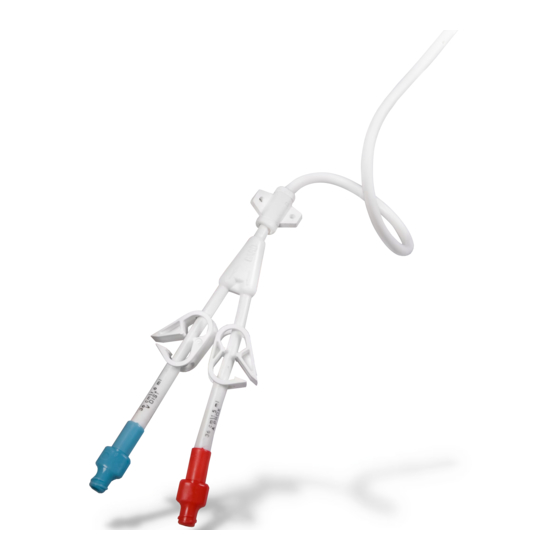
BD Hickman Folleto De Instrucciones
Folleto de información para el paciente, catéteres venosos centrales
Idiomas disponibles
Idiomas disponibles
Enlaces rápidos
Hickman
and Broviac
Central Venous Catheters
ENGLISH
Patient Information Brochure
This patient information brochure is designed to help you better understand
your Hickman™, Leonard™, or Broviac™ Central Venous Catheter, its
use and its care. It will help to answer some questions, but if you have any
additional questions as you read this brochure, please write them down
and discuss them with your health care provider. This patient information
leaflet only addresses information regarding the Hickman™, Leonard™, or
Broviac™ Central Venous Catheters designed for long term vascular access.
Understanding Hickman™, Leonard™, and Broviac™
Central Venous Catheters
What is my device and what is it made of?
A central venous catheter is a soft, flexible, hollow tube used for withdrawing
or giving fluids. One end of the catheter is placed under the skin and into a
central (large) vein above your heart. The other end is outside the skin of the
chest (known as the "exit site"). The part of the catheter that lies underneath
the skin is referred to as the "tunneled" portion, which also contains a tissue
cuff to hold the catheter in place. The cuff on the Hickman™, Leonard™,
and Broviac™ Central Venous Catheters is known as the SureCuff™ Tissue
Ingrowth Cuff.
These catheters are made of silicone and may be separated into one
(single), two (dual), or three (triple) channels called lumens. Screw-like
polyester ("luer lock") connectors on the ends of the lumens allow caps,
syringes, and additional tubing to be securely connected. Table 1 shows
the materials for the Hickman™, Leonard™, and Broviac™ Central venous
Catheters.
Table 1: Material Composition for Hickman™, Leonard™,
and Broviac™ Central Venous Catheters
Device Name
Component
Catheter Tubing
Hickman™,
SureCuff™ Tissue
Broviac™ and
Ingrowth Cuff
Leonard™
Central
Luer Locking Catheter
Venous
Hub
Catheters
Thumb Clamps
Your doctor has chosen a catheter that will fit your medical needs.
Figure 1 shows each of the types of catheters and some of the main parts
of the device. Some of this will be inside of your body, and you will see a
catheter tube coming out of your skin with the lumens. At the end of each
lumen is a connector, which can be used for infusions (medication or fluid
given through your catheter). You may see a small lump under your skin
where the catheter cuff is located. This cuff helps keep your catheter in
place.
A sterile dressing (clear bandage) will be placed over the catheter site to help
keep it free from bacteria. If your dressing becomes dirty, a new dressing
should be placed. See the section "Catheter Care and Maintenance" for
details on how to care for your catheter.
Each lumen will have a small polypropylene clamp attached to it, to close
the catheter when not in use. When not in use, be sure to keep the clamps
locked by pressing down on the clamp so that it clicks into place.
, Leonard
™
™
™
Material or substance to which
patient may be exposed
Silicone
Dacron
Delrin
Polypropylene
Single Lumen
1
2
3
4
5
1. Connectors
2. Attached Clamps
3. Protective Clamping Sleeve
4. SureCuff™ Tissue Ingrowth Cuff
5. Catheter
Figure 1: Single, Dual, and Triple Lumen Central Venous Catheters
When is my device typically used?
Hickman™, Leonard™ and Broviac™ Catheters are designed for long term
vascular access and for use in patients that lack adequate peripheral venous
access. They are available in single, dual, and triple lumen catheters.
All Hickman™, Leonard™ and Broviac™ Central Venous Catheters are
designed for the administration of I.V. fluids, blood products, drugs, and
parenteral nutrition solutions, as well as blood withdrawal.
Note: While smaller lumen Broviac™ Catheters have been used
successfully for blood withdrawal, their small lumen sizes increase the
chance of clotting.
When should my device not be used?
The device should not be used if:
•
You have an infection or think there may be an infection from the device
(bacterial, sepsis)
•
Your body size is insufficient for the size of the implanted device
•
You have allergies to the materials that the device is made of, or
suspect you may have allergies to these materials
•
You have an ongoing or severe lung condition that makes it difficult to
breath (you may need a different insertion or placement of the device)
•
You have had radiation at the location that this catheter would be
inserted or placed
•
You have had blood clots (venous thrombosis) or a surgery or
procedure at the vein or location where this device would be used.
Understanding Your Medical Procedure
What is Central Venous Catheter Placement?
Figure 2: Catheter Placement
in the Chest
During the catheter placement procedure, you may be given medications for
pain and to help you relax or fall asleep. In some cases, you may be awake
during the procedure. If you are concerned about this, be sure to talk with
your doctor.
After the procedure, you will have some time to recover until the sedation
wears off. Before you leave the hospital, a nurse or doctor will tell you some
information about activities that you can do and instructions on how to care
for your catheter. As always, if you have questions or concerns, contact
your doctor's office for more information, as your doctor knows your medical
history best.
1
Dual Lumen
Triple Lumen
1
2
3
5
4
There are several locations that Central
Venous Catheters (CVCs) can be placed.
Your doctor will choose a location that works
best for you. These CVCs can be placed in
the chest, upper thigh, or neck. (See Figure 2
for an example of where your catheter could
be placed).
Most CVCs are placed in the chest, but
there may be another location that is better,
depending on the health of your veins.
For some patients, the procedure is done as
an "outpatient" procedure, which means that
you will go home on the same day as your
procedure. Other times, patients may spend
some time in the hospital after the procedure.
1
2
3
5
4

Manuales relacionados para BD Hickman


Resumen de contenidos para BD Hickman
- Página 17 Folleto de información para el paciente Este folleto de información para el paciente está diseñado para ayudarle a comprender mejor su catéter venoso central Hickman™, Leonard™ o Broviac™, así como su uso y su cuidado. Esta información ayuda a responder algunas preguntas, pero si tiene más preguntas al leer este 1.
- Página 18 Catéter o manguito que penetra la piel (erosión del catéter o manguito a centrales Hickman™, Leonard™ y Broviac™. Su médico le ayudará a través de la piel) determinar si un catéter venoso central Hickman™, Leonard™ o Broviac™ es • Obstrucción del flujo sanguíneo por un trozo del catéter (embolia del adecuado para usted.
- Página 19 La mayoría de los catéteres completamente y séquelas con una toalla limpia o con toallas Hickman™ y Broviac™ vienen con pinzas previamente acopladas y de papel limpias. manguitos de sujeción reforzados. Si no está seguro del tipo de pinza Abra cuidadosamente el kit de vendaje o desenvuelva los materiales, que debe utilizar, póngase en contacto con el médico.
- Página 20 RMN de la presencia del implante y muéstrele su tarjeta de implante. Seguridad durante la toma de imágenes por resonancia magnética (RMN) Los catéteres Hickman™, Leonard™ y Broviac™ no se han evaluado para comprobar la compatibilidad con RMN. Para Australia: cualquier incidente grave que se produzca en relación con el dispositivo debe ser informado a Bard Access Systems y a Therapeutic Goods Administration (https://www.tga.gov.au/).
- Página 70 Becton, Dickinson and Company eller dets tilknyttede selskaper. © 2021 BD. Med enerett. Patient Information Website A BD, a BD logó, a Bard, a Broviac, a Hickman, a Leonard és a SureCuff a Site Web d’information à l’intention des patients Becton, Dickinson and Company vagy kapcsolt vállalkozásainak védjegyei.