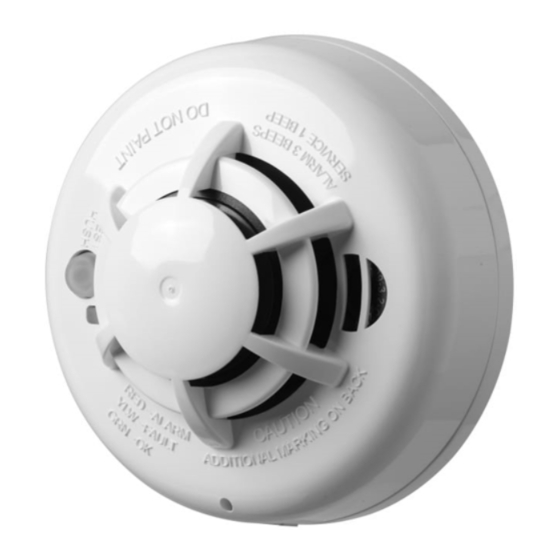
Johnson Controls PG8932 Instrucciones De Instalación Y Funcionamiento
Tabla de contenido
Idiomas disponibles
Idiomas disponibles
Enlaces rápidos
PG8932/PG9932 wireless heat detector
Installation and operating instructions
Read this instruction sheet thoroughly before installation and use of the PG8932/PG9932
Introduction
The PG8932/PG9932 is a wireless heat detector with a fixed temperature, a rate of rise heat
sensor, and an internal piezoelectric alarm. The detector is available in 915 and 868 MHz
versions. Only Model PG9932 operating in band 912-919MHz is UL/ ULC listed. Model
PG8932 operating in 868MHz band is CE and UKCA compliant.
Compatible devices
Model PG9932 is compatible with UL/ULC listed control panels
DSC/Tyco models: HS2128, HS2064, HS2032, HS2016,
HS3248, HS3128, HS3032 when using RF Transceiver
HSM2HOST9 or Keypads with integral transceiver
HS2LCDRF(P)9, HS2LCDRFPRO9, HS2LCDICNRF9(P)
and Qolsys IQPanel2, IQHub, IQPanel4.
Operation
During normal operation, the green LED flashes every 12 seconds.
The detector goes into alarm when the heat level exceeds 135 ºF / 57.5 ºC and automatically
restores when the heat level falls below the threshold. The detector also goes into alarm
when the temperature rapidly increases over a short period of time. During an alarm, the
LED flashes once per second and the sounder emits the evacuation temporal pattern.
Detector trouble
If the detector has a general fault, the yellow LED blinks once every four seconds and the
detector emits a chirp every 48 seconds. After four hours, the panel displays a fire trouble
message.
Table: Detector and Status Indication
Status
LEDs
Normal
Green flash every 12 seconds
Heat Alarm Red flash every 1 second
Heat Test
Red flash every 1 second
Test Alarm
(button
Red flash every 1 second
press)
Detector
Yellow flash every 4 seconds
Trouble
Low Battery Yellow flash every 12 seconds
Power-up
Red, yellow, green, flash sequence
Red, yellow, green flash sequence every
Tamper
12 seconds
Wireless transmissions
A supervisory message is transmitted at 128 s intervals. If the signal is not received, the
control panel determines that the detector is missing.
The detector transmits the following:
•
Idle (normal operation): The detector is in normal state without any faults or
alarms.
•
Operating temperature: 32°F to 100°F (0°C to 37.8°C)
•
Heat Alarm: Active when the detector is above 135°F (57.5°C) or the rate of
rise of temperature is above 15°F/min (8.3°C/min).
•
Tamper / Tamper Restore: (tamper switch activated) ten-second
maximum delay on restore before transmission.
•
Low battery pre-warning: Low battery state is sent to the panel.
•
Low Battery: (battery voltage falls below threshold). Low Battery Trouble is
indicated on the detector by LED flash and chirp and sent to the control
panel.
•
Detector Trouble: Troubles are transmitted at the time of occurrence (one
trouble per supervisory interval).
Sounder
Off
ANSI S3.41 temporal 3
ANSI S3.41 temporal 3
ANSI S3.41 temporal 3
One chirp every 48 seconds
One chirp every 48 seconds
(press button to hush for 12 hours)
One chirp at the end of the power-up
sequence
Off
Tabla de contenido

Manuales relacionados para Johnson Controls PG8932

Resumen de contenidos para Johnson Controls PG8932
-
Página 16: Detector De Calor Inalámbrico
ANSI S3.41 temporal 3 versiones de 915 MHz y de 868 MHz. Solo el modelo PG9932 que opera en la banda de 912-919 MHz está homologado por UL/ULC. El modelo PG8932 que opera en la banda de Alarma de prueba Parpadeo rojo cada 1 segundo ANSI S3.41 temporal 3... -
Página 17: Instalación Y Reemplazo De La Batería
• 3. Inserte una nueva batería CR123A o DL123A, que se Batería baja: (la tensión de la batería desciende por debajo del umbral). El problema de batería baja se indica en el detector a través del parpadeo del puede obtener en un distribuidor Panasonic o LED y un chirrido y se envía al panel de control. -
Página 18: Monte La Placa Posterior Del Detector
Para activar el dispositivo, complete los siguientes pasos: El detector de calor inalámbrico PG8932/PG9932 se instalará y usará en un ambiente que 1. Consulte el manual de instalación del panel de control para ver el conjunto completo presente un grado de contaminación 2 como máximo y categoría de sobretensiones II en de las instrucciones de activación y los procedimientos de pruebas. -
Página 19: Prueba De Diagnóstico Del Detector
Nota: El detector debe estar en modo local o de diagnóstico para hacer la prueba de Instrucciones del propietario calidad de las conexiones. Pruebas del detector En modo de diagnóstico, si se presiona el botón de prueba durante más de 10 segundos, se envía un mensaje de alarma al panel y suena una señal de alarma Siga el procedimiento de prueba que se describe aquí... -
Página 20: Especificaciones
Los procedimientos de instalación, pruebas y mantenimiento estarán de acuerdo con NFPA72, CAN/ULC-S524 y CAN/ULC-S536 CAN/ULC Especificaciones • Homologaciones reglamentarias: FCC/ISED Canada/CE; UL521/ULC-S530 • Diámetro: 127 mm (5 in) • Altura: 50,8 mm (2 in) • Peso (incluida la batería): 198,4 g (7 oz) •... -
Página 21: Garantía Limitada
Los detectores de movimiento pasivos infrarrojos operan detectando cambios en la temperatura. Sin embargo su efectividad puede ser reducida cuando la temperatura del Garantía Limitada ambiente aumenta o disminuye de la temperatura del cuerpo o si hay orígenes intencionales o sin intención de calor en o cerca del área de detección. -
Página 22: Información Reglamentaria
Clase B, de El detector de calor inalámbrico PG8932/PG9932 tiene una vida de servicio recomendada de conformidad con la Parte 15 de la normativa de la FCC. Esos límites están destinados a 10 años bajo condiciones de uso normales. - Página 29 Rev. 0 (10/21)