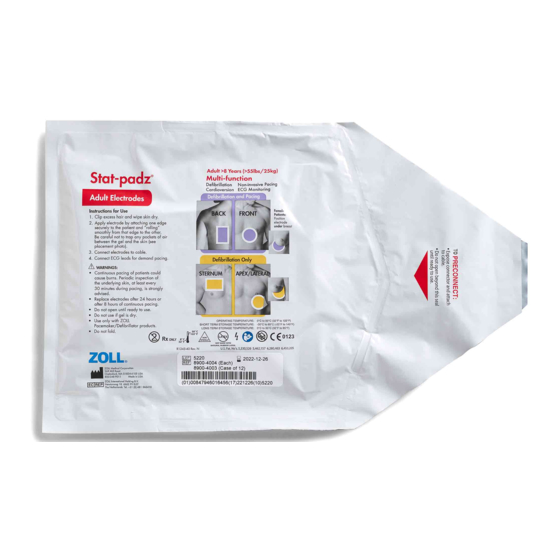
ZOLL Stat-padz Instrucciones De Uso
Tabla de contenido
Idiomas disponibles
Idiomas disponibles
Enlaces rápidos
Stat-padz
Multi-function, Pro-padz
®
OPERATING TEMPERATURE:
SHORT TERM STORAGE TEMPERATURE:
LONG TERM STORAGE TEMPERATURE:
ENGLISH / Page 1 of 24
Intended Purpose: To transfer energy for de brillation, cardioversion, non-invasive pacing therapy to the heart and provide ECG monitoring.
Indications for use: For use on adult patients with ZOLL® R Series®, X Series®, X Series® Advanced and Propaq® MD by trained personnel including Physicians, Nurses,
Paramedics, Emergency Medical Technicians and Cardiovascular Laboratory Technicians. The Stat-padz and Pro-padz electrodes are not indicated for use on a patient
less than 8 years of age or weighing less than 55lbs (25kg).
1. Do not open until ready to use.
2. Periodically inspect electrode packaging for integrity & expiration date.
3. Open the rst stage of the Speed Pack and expose the connector. Be careful not to open the second seal (beyond the point of red arrow)
until ready to use.
4. Attach to connector of a ZOLL multifunction cable.
Instructions
1. Remove excess chest hair. Clip if necessary to maximize gel to skin contact. Clipping is recommended
since shaving can leave tiny microabrasions that can lead to patient discomfort during pacing.
2. Ensure skin is clean and dry under electrode. Remove any debris, ointments, skin preps, etc.
with water (and mild soap if needed). Wipe o excess moisture/diaphoresis with dry cloth.
Instructions
1
1. Apply one edge of the electrode securely to the patient.
2. "Roll" the pad smoothly from that edge to the other. Be careful not to trap
Pad
Skin
any pockets of air between the gel and skin.
2
Anterior-Posterior
Recommended for de brillation, non-invasive pacing, ventricular cardioversion,
and ECG monitoring. Optimal for non-invasive pacing because it increases patient
tolerance and decreases capture thresholds.
Posterior:
Grasp the Posterior electrode at the red tab and peel
away from the plastic liner. Place to the left of the spine
just below the scapula at the heart level.
Always apply Posterior electrode rst. If Anterior electrode
is already in place when patient is being maneuvered for
placement of the Posterior, the Anterior may become
partially lifted. This could lead to arcing and skin burns.
Anterior Apical:
Grasp the Anterior Aprical electrode at the
red tab and peel away from the plastic liner.
Apply over cardiac apex with the nipple under
adhesive area on a male patient. Position
under breast on a female patient.
Avoid any contact between nipple and gel
treatment area. Skin of the nipple area is
more susceptible to burning.
CARDIOVERSION
Elective cardioversion may cause visible
reddening under the surface of a
de brillation / pacing / monitoring
electrode. This e ect is likely caused by
hyperemia (excess blood) under the surface
of the skin and is probably not a "burn".
During cardioversion, in contrast to a
standard de brillation, the patient is
normally perfused. The impact of the
energy passing through engorged
capillaries under the skin's surface can
cause blood to di use out, creating an
e ect that often looks like a burn or rash.
The reddening typically goes away within
a few days.
Among the factors that contribute to this
phenomenon are:
1) high energy settings
2) multiple, successive shocks
3) skin integrity
4) patient age
5) certain antiarrythmic drugs
Blistering and/or sloughing do not typically
result from cardioversion and should be
considered an indication of burning due
to other factors.
Radiolucent
®
°
°
°
°
0
C to 50
C (32
F to 122
F)
°
°
°
°
-30
C to 65
C (-22
F to 149
F)
°
°
°
°
0
C to 35
C (32
F to 95
F)
Preconnecting the Electrodes (Optional)
ELECTRODE APPLICATION
ELECTRODE PLACEMENT
POSTERIOR
ANTERIOR APICAL
1.
After patient movement due to muscle contraction or patient repositioning, press
pads to skin to ensure good coupling between pads and skin.
2.
Do not conduct chest compressions through the pads. Doing so may cause
damage to the pads that could lead to the possibility of arcing and skin burns.
3.
Transcutaneous pacing may cause burns to the skin. Periodically check the
electrode site to ensure that the electrodes are well adhered to the skin.
4.
During transcutaneous pacing, do not exceed the maximum pacing settings
of 1 hour of pacing (140 mA/180 ppm) or 8 hours of pacing (100 mA/100 ppm).
Doing so can increase the possibility of skin burns.
5.
Replace electrodes after 24 hours of skin contact or 8 hours of pacing (2 hours of
pacing for Radiolucent) to maximize patient bene t.
6.
Do not use if gel is dry. Dried out gel can lead to skin burning. Do not open pouch
until ready to use. Do not use electrodes past the expiration date printed on the
pouch label.
7.
To avoid electrical shock, do not touch the pads, patient, or bed when de brillating.
8.
Do not discharge standard paddles on or through electrodes or place separate ECG
leads under pads. Doing so could lead to arcing and/or skin burning.
9.
Always apply electrodes to at areas of skin. If possible, avoid folds of skin such as
those underneath the breast or those visible on obese individuals.
10. Avoid electrode placement near the generator of an internal pacemaker, other
electrodes or metal parts in contact with the patient.
11. Some current generated by electrosurgical units (ESU) may concentrate in the
conductive gel of pacing / de brillation electrodes, especially if an ESU grounding
pad other than that recommended by the ESU manufacturer is used. Consult the
ESU operator's manual for further details.
50° C
122° F
MD
IPXX
Rx
ONLY
0° C
32° F
SKIN PREPARATION
Recommended for de brillation and ECG monitoring only.
Not optimal for non-invasive pacing. Non-invasive pacing with this con guration
can lead to decreased patient tolerance and increased capture
thresholds.
Anterior Sternal:
Grasp the Anterior Sternal electrode at the red tab and peel away
from the plastic liner. Apply on the patient's upper right torso.
Avoid any contact between nipple and gel treatment area.
Skin of the nipple area is more susceptible to burning.
Anterior Lateral:
Grasp the Anterior Lateral electrode at the red tab and
peel away from the plastic liner. Apply so that the top of
the gel treatment area lines up with the bottom of the
pectoral muscle on a male patient. Position electrode
under the breast on a female patient.
Placement of Anterior Lateral electrode varies slightly
in anterior-anterior con guration. The more lateral
placement increases the likelihood that more of the
heart musculature will be within the current pathway.
WARNINGS
Instructions for Use
NOT MADE WITH
NATURAL RUBBER LATEX.
January 2024 / R1345-112 Rev. J
Excessive hair can inhibit good
coupling (contact), which can
lead to the possibility of arcing
and skin burns.
Poor adherence and/or air
under the electrodes can lead
to the possibility of arcing and
skin burns.
Anterior-Anterior
12. Do not fold the electrodes or packaging. Any fold in or other damage to the
conductive element could lead to the possibility of arcing and/or skin burns.
13. Use only with ZOLL pacemaker/de brillator products.
14. Device disposal should follow hospital protocol.
15. Do not use electrodes in the presence of oxygen-rich environment or other
ammable agents. Doing so could cause explosion.
16. If any serious incident has occurred in relation to the device, the incident should
be reported to the manufacturer and the competent authority of the Member
State in which the user and/or patient is established.
17. If repositioning of the electrodes is needed, consider replacement with a new
electrode.
Do not break
1
inner seal
2
ANTERIOR STERNAL
ANTERIOR LATERAL
®
ZOLL Medical Corporation
269 Mill Road
Chelmsford, MA 01824-4105 USA
800-348-9011
Made in USA
ZOLL International Holding B.V.
Einsteinweg 8A
6662 PW Elst, Netherlands
ZOLL Medical Switzerland AG
Baarerstrasse 8
6300 Zug, Switzerland
Tabla de contenido

Manuales relacionados para ZOLL Stat-padz


Resumen de contenidos para ZOLL Stat-padz
-
Página 5: Colocación De Los Electrodos
Finalidad prevista: Transferir energía para des brilación, cardioversión y tratamiento de estimulación no invasiva al corazón y proporcionar monitorización electrocardiográ ca. Indicaciones de uso: Para uso en pacientes adultos con los des briladores ZOLL® R Series®, X Series®, X Series® Advanced y Propaq® MD por parte de personal cuali cado, como médicos, personal de enfermería, auxiliares sanitarios, socorristas, técnicos de urgencias médicas y técnicos de laboratorios cardiovasculares.